
TacticalGear4Life is supported by you, its above average Studly and Masculine audience. When you make a purchase through our links below which may be affiliate links, we may earn an affiliate commission, this in no way affects you or the cost of your gear.
In real-world defensive shooting, whether protecting your home or facing a sudden threat, a proper shooting stance is the essential starting point for reliable performance.
It gives you the balance and control needed to handle recoil effectively, stay steady under stress, move effectively, and place accurate shots when it matters most.
Without a solid, natural stance, even a good grip and trigger work can break down during movement due to fatigue or the chaos of an actual encounter.
The right stance keeps your body positioned naturally, allowing quick adjustments, smooth transitions between pistol and carbine if needed, and better overall control in tight or unpredictable spaces.
This isn’t about princessy range routines or a friendly competition where everyone hugs afterward; it’s about creating a practical foundation that works when the situation turns serious, and lives are on the line.
In this article, we explore why a proper shooting stance is so important for personal defence and how to develop one that holds up in real scenarios.
TABLE OF CONTENTS
CHECK OUT MORE GREAT GEAR
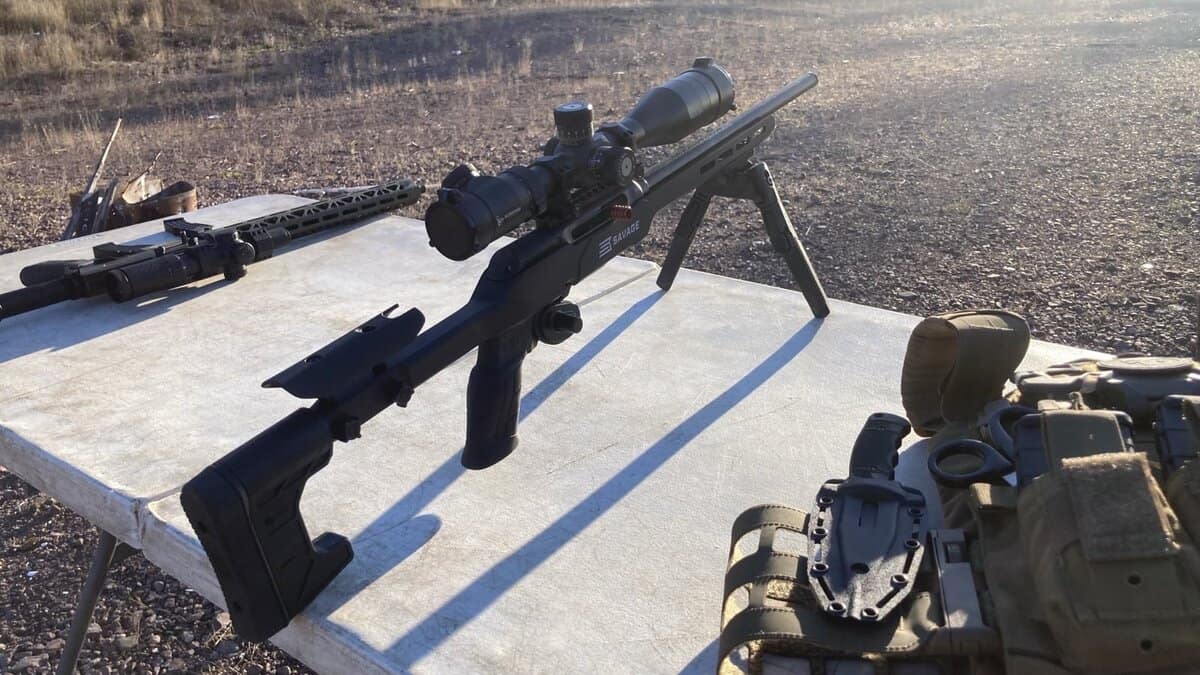
Best .22 Semi-Automatic rifles
The 7 Best Plate Carriers On Amazon
THE MYTH THAT STANCE DOESN’T MATTER
You’ve probably heard the old rumour floating around shooting circles: “Stance doesn’t really matter, just point and shoot however feels natural, and you’ll be fine.
It’s an appealing idea, especially for beginners who want to skip the fundamentals and jump straight to pulling the trigger.
Some even claim that in a real defensive situation, instinct takes over, and any stance works as long as you hit the target.
But the truth of the matter is that that’s just not true. Stance absolutely does matter, and pretending otherwise sets people up for failure when things get serious.
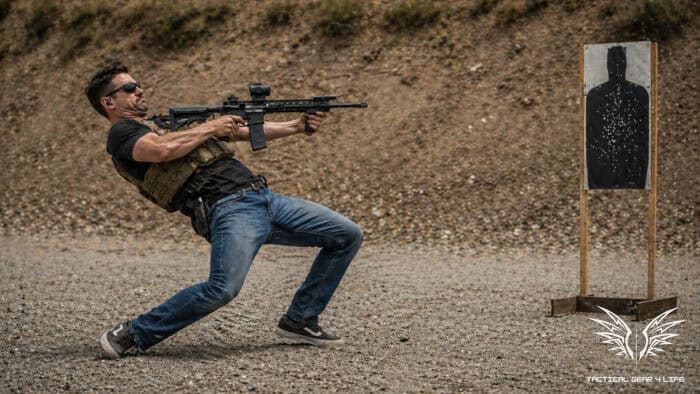
WHY DOES A PROPER SHOOTING STANCE MATTER
The reality is that a proper shooting stance matters a great deal because it directly supports your ability to respond effectively when a real defensive situation unfolds.
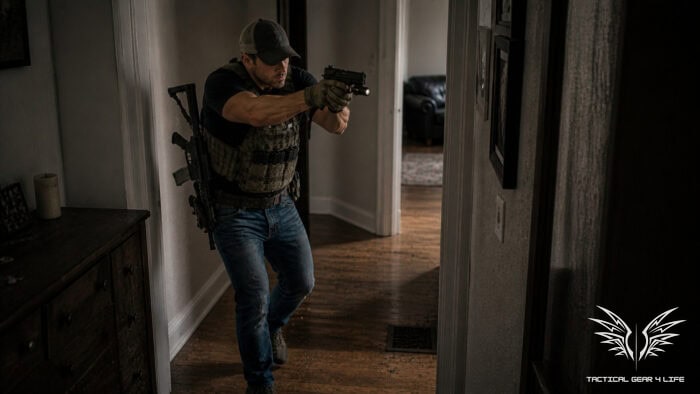
It influences how well you can control your forward movement, manage the firearm under stress, and adapt to whatever the environment or threat demands, whether that’s inside your home, in a hallway, or during an unexpected encounter.
A well-chosen stance sets up the conditions for accurate shot placement, quick follow-ups, continuous mobility, and overall control in high-pressure moments, rather than leaving those outcomes to chance or pure instinct.
Ignoring or downplaying a good shooting stance creates unnecessary variables that can compromise performance exactly when you need it most.
In the end, stance provides three essential elements that form the practical foundation of defensive and offensive shooting: protection, stability, and mobility.
PROTECTION
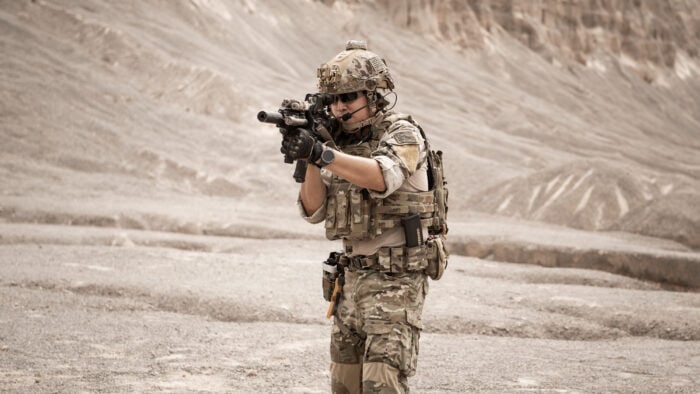
A proper shooting stance significantly improves your personal protection by ensuring your armoured plates are fully presented toward the threat while minimizing exposure of vulnerable areas.
STABILITY
A proper shooting stance delivers the stability required to maintain consistent recoil management and precise shot placement, as well as faster recovery between shots and more consistent follow-ups.
This built-in steadiness reduces unnecessary body sway or rocking, helping maintain tight shot groups even when adrenaline is high, or you’re firing from less-than-ideal positions like around cover or in confined home spaces.
MOBILITY
A proper shooting stance provides mobility, allowing you to move while maintaining control of the firearm. It supports forward movement, lateral steps, and retreats without losing balance or disrupting your sight alignment.
This means you can reposition to cover, adjust distance from a threat, or navigate confined spaces like hallways without having to stop shooting or sacrifice precision.
The stance also enables smooth directional changes and keeps the gun oriented and ready during movement, so you retain the ability to engage effectively while on the move rather than being limited to stationary positions.
WHAT A GOOD SHOOTING STANCE LOOKS LIKE
Back in the day, the military taught us what we called the gunfighter stance: feet shoulder-width apart, perfectly squared to the threat, with our upper body leaning forward.
It looked aggressive and seemed to make sense at the time, but it had real drawbacks.
The squared base severely limited our ability to rotate at the waist, preventing us from maintaining a 360-degree view, and leaning forward opened a dangerous gap where rounds could slip in above our plates.
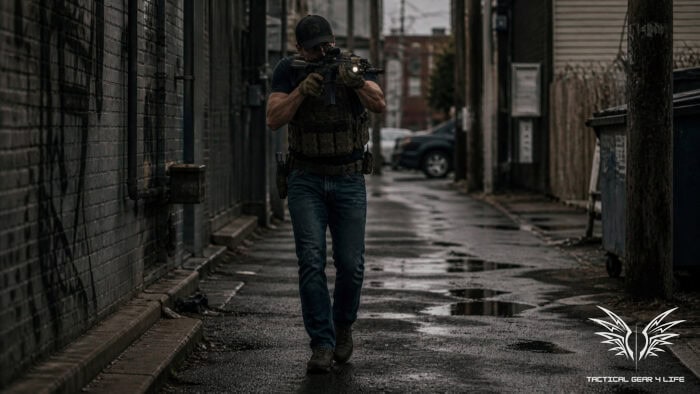
Over time, this evolved into the far more practical and effective shooting stance principle: “Shoot as you walk.” This principle gave us the walking stance, or staggered stance.
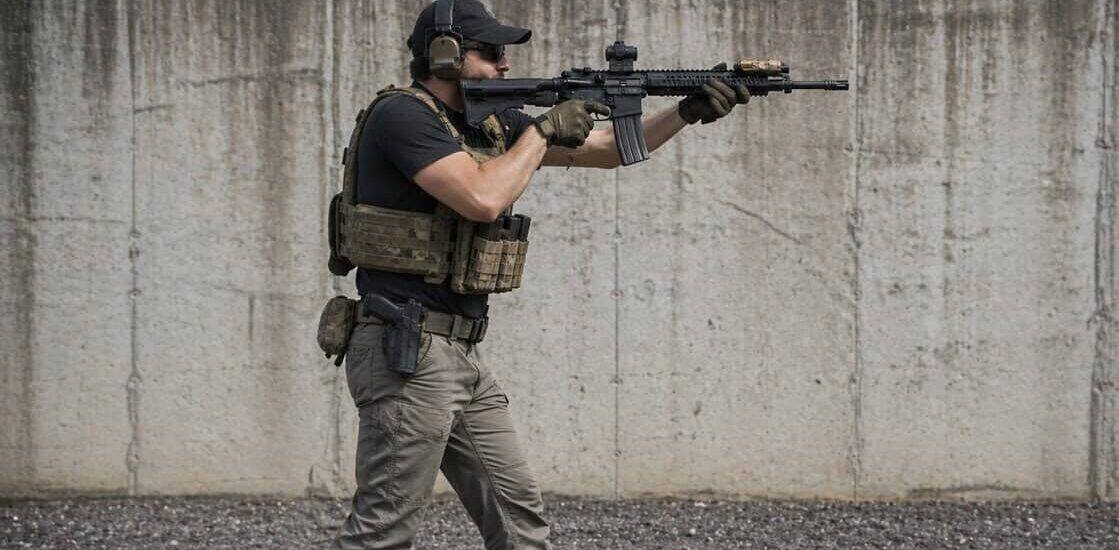
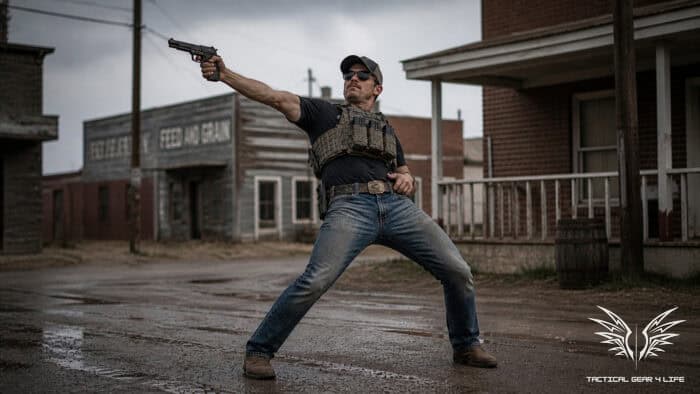
Start with one foot slightly forward in a natural, slightly exaggerated step, knees bent just enough to stay athletic and not rigid, like you could step through and deliver a big boot to a threat’s chest.
While keeping your chest and upper body upright, so your plates are fully presented to the threat with no vulnerable gap over the top.
This setup gives you excellent rotation to scan and track what’s happening around you, lets your legs better absorb recoil from any weapon system (and lock solid if you’re running something heavy like an LMG on full auto).
Also keeps your mobility high, so you can advance, pivot, or adjust without losing balance or control. It’s simple, natural, and built for the real fight.
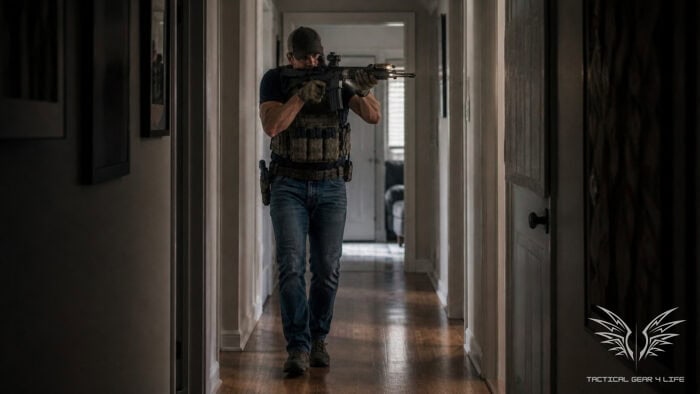
HOW TO BUILD AN ELITE LEVEL SHOOTING STANCE
Now that we’ve covered why the “Shoot as you walk” stance outperforms the older “Gunfighter” style, let’s get into how you can start building your stance.
FOOT PLACEMENT
Begin by standing naturally, feet about shoulder-width apart, just like you would if you were standing relaxed.
From there, take a slightly exaggerated step forward with one foot (usually your strong-side foot back, weak-side forward, but experiment to find what feels most natural for you).
Keep your toes in line with each other, no extreme turnout or pigeon-toeing, so your base stays balanced and athletic.
The stance should feel comfortable and dynamic, almost like a boxing or fighting stance: ready to move forward, backward, or laterally without stiffness or awkwardness.
If it feels locked, rigid, or unbalanced, adjust the step length until it’s instinctive, because this foot position sets up everything else for recoil absorption, mobility, and natural rotation.
KNEE BEND
Your knees should never be locked straight and rigid; it limits movement and makes it harder to react quickly.
Instead, keep them slightly bent in a relaxed, athletic posture, just enough to feel springy and ready to move.
This natural bend gives you immediate access to dynamic adjustments: stepping forward, stepping back, rotating sideways, throwing a straight kick, or transitioning to hands without seeming slow and stiff.
At the same time, the stance allows you to instantly lock up your rear leg and knee from your foot to your waist, driving the rear foot into the ground when needed.
By driving your weight down and stiffening that back leg and knee on demand, you create a rock-solid base to better control heavy recoil and keep rounds on target, then return back to the bent position for mobility.
It’s a simple on/off switch between fluid movement and braced stability, all without changing your overall foot placement or upper-body alignment.
HIPS
Keep your hips forward, squared, and inline with the threat.
This position helps drive your body weight into the shot, improves stability, and lets you transition smoothly between targets without losing balance.
Keeping your hips inline makes a noticeable difference during dynamic drills, especially when you’re covering ground in rough terrain.
CHEST, BACK & SHOULDER POSTURE
Lastly, your back should be straight and upright, with your chest out, and your shoulders relaxed; do not lean forward. This position should feel natural, not forced or rigid.
Ensure your head is in a neutral position, looking straight forward. Allowing you to bring the gun sight up to your eye rather than uncomfortably dropping your head to the sight.
This ensures your plates are fully presented to the threat and stay that way as you move forward.
It also offers a good balance, helps manage recoil, and, possibly most importantly, allows your upper body to rotate freely when needed.
FAQS
WHAT ARE COMMON MISTAKES IN A SHOOTING STANCE?
The biggest mistakes include standing with feet squared up and in line (old gunfighter stance), locking the knees straight and rigid, leaning the upper body too far forward, and standing too tall and stiff with no knee flex.
As well as dropping the head down to the sights instead of bringing the gun to eye level, and staying completely static instead of staying ready to move.
These habits usually come from range training or competition influence and can limit mobility, reduce recoil control, and leave you more exposed in a dynamic defensive encounter.
HOW DO I KNOW WHEN MY STANCE IS GOOD?
Your stance is good if it feels natural and balanced, like a slightly aggressive walking position you could hold comfortably for a while or use to deliver a straight kick.
You should be able to move forward, sideways, or backward smoothly without losing control of the gun or your balance.
It should allow you to absorb recoil well, keep good sight alignment while firing multiple shots, and let your upper body rotate freely to scan your surroundings.
If it feels rigid, awkward, or tiring after a few minutes, make small adjustments to your foot placement and upper-body position until it feels relaxed yet explosive and ready for real movement.
IS THERE A DIFFERENCE BETWEEN STANCE IN COMPETITION VS REALITY-BASED/TACTICAL SHOOTING?
Yes, there’s a clear difference: competition shooting (like USPSA or IDPA) tends to be more static or semi-static, with shooters engaging fixed targets.
From known positions within shooting boxes or fault lines, where there are no real threats, no incoming fire, and minimal need for full-body movement or 360-degree awareness.
The focus is on speed and precision in a controlled, predictable environment.
Reality-based tactical and defensive shooting, however, is inherently dynamic.
You’re facing moving threats, unpredictable angles, confined spaces like home hallways, potential incoming rounds, and the constant need to move while shooting.
The “shoot like you walk” principle is designed for this chaos, prioritizing mobility, situational awareness, effective armour presentation, and delivering accurate fire on the move.
Competition optimizes for winning matches against paper; tactical shooting is built to survive and win fights against people who shoot back.
FINAL CALL
Mastering a proper shooting stance is one of the most important things you can do to improve your offensive shooting capabilities, taking you from a Joe to a Pro.
By adopting the “Shoot like you walk” stance, you gain the protection, stability, and mobility needed to perform when it actually counts.
This isn’t about looking tactical on the range. It’s about building a practical, instinctive foundation that works in the tight hallways, stressful moments, and unpredictable situations of real home or personal defence.
Take the time to practice this stance, dry fire at home and on the range, until it becomes second nature. Your accuracy, recoil control, and ability to move under pressure will all improve dramatically.
In a fight for your life or your loved ones’, a proper shooting stance may be the edge that makes the difference.